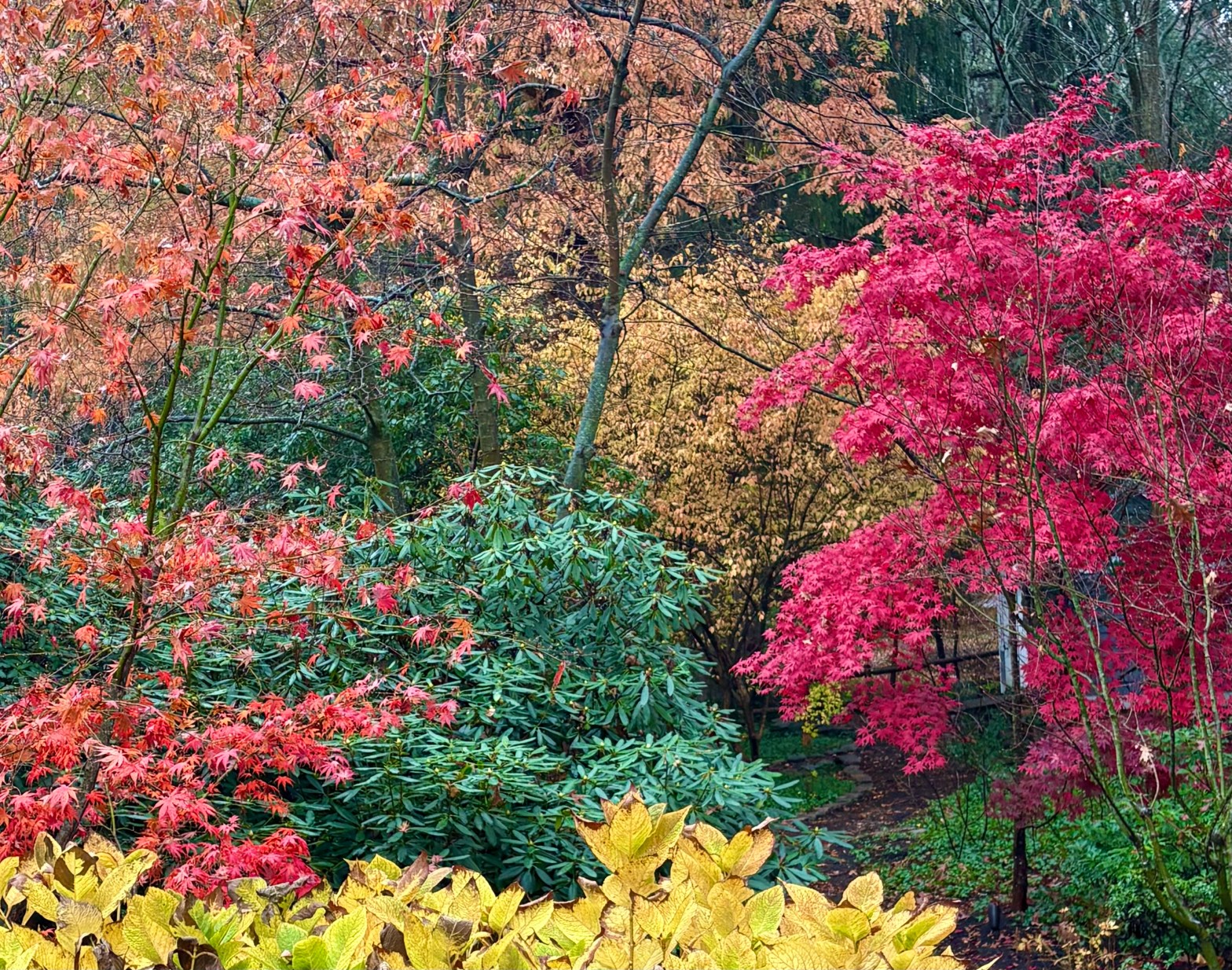
It’s November, so my newsletter is in its paired-down form for Winter. I thought that a discussion on design might be a good topic as we head deep into Fall and weigh what we might contemplate over the Winter for our gardens in the Spring. While I spend a lot of time with clients talking about pruning, identifying plants, garden care, soil testing, and the like, at almost every visit there is some question about design.
So, without giving away all my trade secrets, let’s review some of the critical principles of landscape and garden design. Winter is always a great time to step back. I always suggest taking pictures throughout the season, so you can remember all that is going on, but snapping some photos now will still provide a visual aide for when the snow falls.
Big Picture First
Quite often we get focused on the plants, the new bed, or the space where the tree died, instead of having a vision for our whole landscape. The result often ends up being disparate garden beds with no connection. This doesn’t mean having months of meetings with an architect or designer and creating a master plan, but it does mean stepping back and looking at your landscape in its entirety. While I don’t want to squelch people’s impulsivity to jump in the car when hearing about a plant sale, I prefer that people have a general, long-term plan for their garden on which to execute. I find that asking the right questions and focusing on the big picture can help to create a basic concept for the garden and how to build it.
Does my garden fit the need of me and my family now and in the future? What elements do I aspire to have in my garden: Pond, greenhouse, formal English garden, native meadow, terraced land, raised vegetable beds, Bocce Court, Rose Garden, another relaxation space, and on and on. Sometimes people have never stepped back to think about what they could have and how to create it, even if it is ten years in the future. This is the most fun for me; To help open people’s minds to what might be. It can be expensive in the long-term to just jump in an fill a space without having a plan
Creating an aspirational plan for your garden is a great step. This not only includes the physical aspects of the garden, but the feel. You don’t have to go traditional or native, cottage or formal. You can have different elements in your garden, it is the transition that makes it work. Having a plan, even if it is basic, will help direct your future efforts.
Structural Elements
Walls, walkways, terraces, structures, water elements (ponds, fountains, etc), grading, art, and more tend to be the most expensive aspects of the landscape, but are the most enduring. They can be disruptive to install in the landscape, and are often the first elements when it comes to sequencing. They can transform spaces and can draw you into the garden and frame the space.
I have worked in and managed properties with hardscape elements that have existed for well over a century with minor repairs or work required. These elements should be considered permanent aspects of the landscape, and the investment should reflect their permanence. Too often, people are not willing to invest in this part, instead, looking for the lowest cost option. Instead of lasting decades or centuries, these installations can start to break down in years, requiring significant work to repair. This process of repair will continue until it is constructed properly, and it may ultimately cost more than doing it right the first time. A link below references an article I wrote on just this topic.
A decade ago, a church in my town installed granite steps and bluestone landings for its entrance. There must be at least 30 steps and half a dozen landings on a slope that rises nearly 20 feet. An expensive project. The contractor convinced them that they could dry lay the steps and bluestone on crushed stone, instead of setting them in mortar. Within a couple of years, the large, heavy granite steps started shifting, which led to the bluestone landings settling. Last year they had to close off the steps in Winter because it had become unsafe. The contractor returned to reset everything, and now they are shifting again.
The point of this story is to find a quality contractor to perform this permanent work, and to do it right the first time. It will cost more, but you won’t have to pay to fix it in future years.
Pay close attention to materials. Not everyone wants or can afford natural stone and the expertise it requires to install, but realize that whatever materials you choose will visually hold together your entire outdoor space. Choose your stone or concrete product knowing that they tie the entire landscape together. Ideally, you limit your palette to no more than three different products. More than that and they can lose their cohesiveness and can become distracting.
I was recently on a property that had used cultured field stone on the house foundation, a goshen stone sitting wall with bluestone caps, granite steps into a sun porch, brick terrace and walkways edged with granite, and a concrete block retaining wall to help level the back yard. Sometimes less is more. If the fieldstone was a favorite, I might have used the field stone on the foundation and the wall. If I capped the wall with bluestone, then I might have used this for the terrace instead of brick. To really tie together, I might use chunk bluestone for the steps that come down to the bluestone terrace and then just line the walkways with granite if necessary. Or I could do the granite steps and granite edging on the walkway. This is how you can work to tie things together rather than make elements stand out. We haven’t even gotten to detailed design work with the stone you decide to use.
These permanent elements require significant contemplation and competent implementation.
The Fun Part
Over recent years, I have written a bit about design, touching on color, plants, structure, native, etc. These are often the detailed parts of the landscape or garden to be filled in after you have decided upon a concept or ‘feel’. The challenge is that people often start here and work their way up, and end up with gardens that aren’t what they want.
A client reached out to me several years ago because her garden made her anxious. She had a very full and colorful garden with dozens and dozens of different plants in small groups. It was an almost random collection of color that had no cohesiveness, repetition or structure. The key here is that it made her anxious, so we started to look at decreasing the number of different plants and employing some basic strategies to make it more peaceful and cohesive. It mean’t decreasing the number of different plants, repeating plants, creating larger clusters of the same plant, and working to make some colors work together. She still has a colorful and full garden, but it makes a little more sense and is more relaxing to her eye. She still loves to find new plants, and that is OK.
If there is one thing I hope to communicate in this article: Step back and create a concept or plan for your garden; Understand what is involved to reach your goals and use it as a guide. Know that parts can be changed and determine how that effects other aspects of your garden.
Following are some pieces that I have written on design over the past years. As much as I have been talking about plans and rules, read ‘Throw Out The Color Wheel’, because rules are mean’t to be broken! At the end of the day, it is your garden and should reflect your taste and style.
Designing With Ornamental Grasses
Do Your Landscape Projects Right The First Time
Art And Structure In The Garden
Are Black And White Gardens Actually Colorful
Throw Out The Color Wheel
How To Determine What Plants Are Native In Your Garden, And Why?

