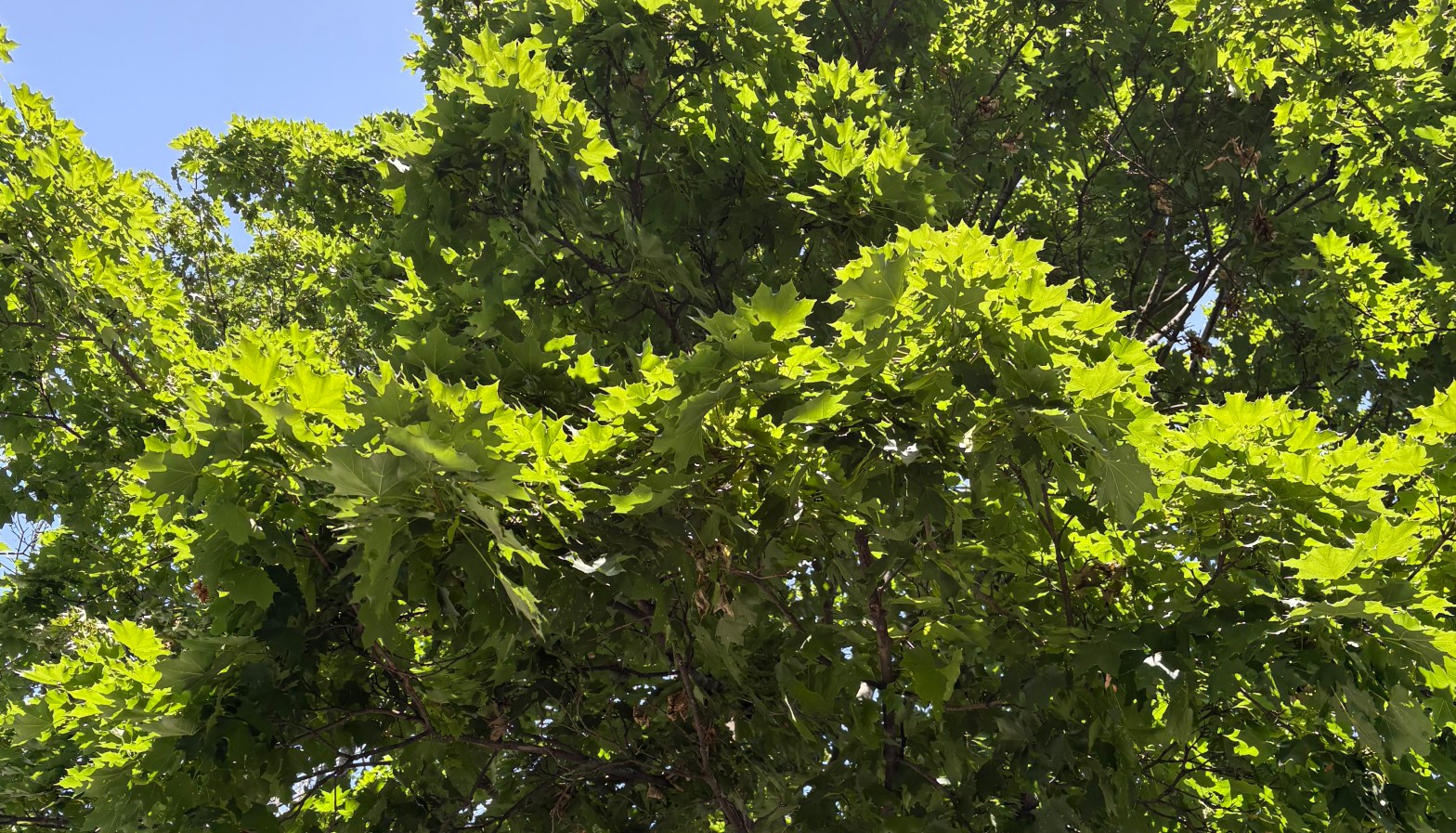
The ubiquitous Norway Maple (Acer platinoides) is a far too common tree in New England, especially as planted street and landscape trees and the many volunteers that continue to take over our suburban tree canopies. While it is tough as nails, it presents a number of problems on the street and in our gardens.
The most common form has a green leaf in the classic Maple form with five lobes, sometimes seven and with sharp points. There is also a muddy red-leafed form and a variegated form. Very similar to our native Sugar Maple, whose leaf lobes have fewer points. Easy way to differentiate is to remove a leaf from the stem, and a milky fluid will come out of the Norway Maple.
It is also very recognizable with its chartreuse green flowers, that come in early Spring, after the red flowers of the Red Maple (Acer rubrum). The real challenge is that it provides little benefit to the plant/insect ecosystem in that its leaves are largely inedible to native insects and caterpillars. With a growing population of these trees that out compete native species, there is less habitat for insects and caterpillars that feed birds. Its roots also secrete a chemical that can limit the growth of other species, which is why it can be difficult to garden underneath.
The Norway Maple has been grown in the US since the 1700s, according to Michael Dirr, but it wasn’t until the 1960s/70s that it became a popular street tree after the demise of our Elms from Dutch Elm Disease. Elm St, is one of our most popular street names because so many streets were lined with elegant Elm trees that were decimated in just a few decades in the middle of the last century. The hardy Norway Maple was a common replacement, and this led to the incredible proliferation of them in our suburban landscapes.
According to research by the US Forestry Service, 17% of all street trees in New England are Norway Maples. In Syracuse, NY, that number is 37%. With all of these planted trees, they have proliferated with their seeds. You may have noticed the bumper crop of tiny seedlings that covered our gardens early this Spring. They were the first things to sprout. If you don’t remove them, they will quickly become small trees. This is the reason many of our back yards and small woodland areas have become dominated by Norway Maples. When they grow to larger size, their dense canopy will shade out competition, as well as with their shallow, dense root network.
I asked Hendrik Wenning of Barrett Tree East, for an arborist’s perspective on the tree, as they spend a lot of time working on them and cleaning up after them.
Hendrik said, “In Europe, the Norway Maple is considered to be a robust and adaptable tree. It copes well with air pollution, heat, drought, and salt. Significantly better than other native to Europe species. It thrives in soils that lack nutrients or are compacted. It provides shade through its dense canopy, and its flowers are out early and prominent in the spring, providing a good food source for many insects.
They were brought to the States approximately 300 years ago, they are thriving in this environment as well. Unfortunately, they are invasive in that they’re crowding out native species. They can create dense canopies that then block out sunlight, which makes it challenging for native species to grow and thrive. Certain parts of the tree contain a biochemical (allelochemical), just like Black Walnuts, that can inhibit the growth of surrounding plants. However, many trees are unaffected by it. Some people argue that the lack of plants growing in its surroundings is simply because of the dense canopy it provides, which shades out other plants.
Norway Maples are not necessarily known for their strong wood. After storms, there’s usually a Norway Maple amongst the trees with broken branches.”
I will add that they have a broad reaching, dense network of feeder roots that extend well out from the trunk. If you have tried to dig or garden under them, you know that it can be hard to dig through these roots, and that they steal most of the water and nutrients you might supply.
The Norway Maple was banned for sale in Massachusetts in 2009. Vermont, New Hampshire, and Maine have also banned the plant for sale or propagation. Connecticut and Rhode Island are legislating its ban currently. Unfortunately, like Jason in the Halloween movie, it’s already in the house.
The challenge is what can we do about an aggressive, invasive plant that is so well established. If we went out and removed every Norway Maple, its impact on the urban tree canopy would be devastating with increased temperatures, soil erosion, increased air pollution, among others.
- Pull seedlings in the early Spring when they are easy to remove.
- Locate small trees in garden and remove.
- Plant succession trees with the idea you would remove the Norway Maple at a later date.
- If you have many Norway Maples in an area, consider removing several to let more light in and plant new, native trees.
- As Hendrik mentioned, they tend to drop branches regularly, so have an arborist provide regular thinning and removal of dead wood to minimize potential damage.
This is an example of well-meaning settlers bringing familiar plants and over time its impact has been to out-compete our own native plant material. While we will never be able to remove them all, we can work to slow their continued expansion, and to replace with better-suited, native trees. With all the challenges with our native Maple, Beech, Hemlock, etc, why can’t we have an insect or disease that affects the Norway Maple?
If you want to subscribe for free to my more detailed newsletter, please go to the following link: The Barker, a newsletter for gardeners in New England.

