A trend has exploded over recent years regarding companies that will spray your garden for ticks and mosquitos. It may be a franchised business focused just on eliminating these pests, or some other business that is filling gaps in their workload during the summer season. The most deceiving part of these pitches is that it is effective and safe for you, your children, your pets, and the environment.
Let’s start with the products used and what they actually do. I am not going to go down the rabbit hole on this, but I will provide enough information so that you can understand the products used. I am not an expert, nor am I a licensed pesticide applicator, but I have accumulated a lot of information over the years from many professionals with whom I work and by reading informed sources for information.
Pyrethroids are the most commonly used ‘chemical’ product. They are broad-spectrum insecticides, a term you may have heard before, with other products you use in your garden. It means that it kills most everything in its path. Many companies will come in a spray your entire garden with these products, killing everything, on contact, including ticks. If sprayed in the evening, when fewer insects are out, its residual will still kill in subsequent days. It is highly effective, however, it kills all bees, butterflies, fireflies, ladybugs and other beneficials insects that are responsible for keeping your garden in balance. When we use products like this we leave no defense for large scale infestation of insects that will soon return to the garden.
There are other chemical products that are slightly less toxic on a broad scale, but they all will significantly impact the beneficial insects in your garden. All these chemical products kill active adult mosquitos, but do nothing for larvae or breeding grounds for mosquitos, meaning that they will return as larvae hatch. It is also temporary for ticks as deer, mice, rabbits, dogs, cats and other critters that are vectors for them to return to your garden. All of these products are considered ‘safe’ for humans and pets (not cats and fish) when they are dry. I have been writing a bit about the interdependence of animals, insects, native flowers, birds, etc, and if you start removing part of the ecosystem, it impacts every other part. Birds, bats and others consume huge amounts of insects, and if you remove them, your are removing their food source.
Safe, natural sprays are an alternative. They are often oils like Cedar, Eucalyptus, and others. These are far less effective at killing on contact, though they do have some efficacy with mosquitos and ticks. Again, they will impact pollinators and other insects too. The downside to these treatments is that they have no barrier or residual effects like the Pyrethroids, and will only decrease populations for a few days. These products are far safer for pets and humans, but have little impact and are for the short term.
Please reconsider using these companies and products. Their efficacy and danger to beneficial insects, pollinators and pets is not worth it for short term relief, in my opinion. They are not solving a problem, but just indiscriminately killing insects.
If you keep reading, I will provide the good news.
I wrote last year about the Mosquito Bucket Challenge which uses something called the ‘Bucket of Doom’ put forward by Doug Tallamy and the Homegrown National Parkorganization. I did it, and I had a number of clients who did it, and I heard that a number of my readers did it, and it was highly effective, when followed accurately.
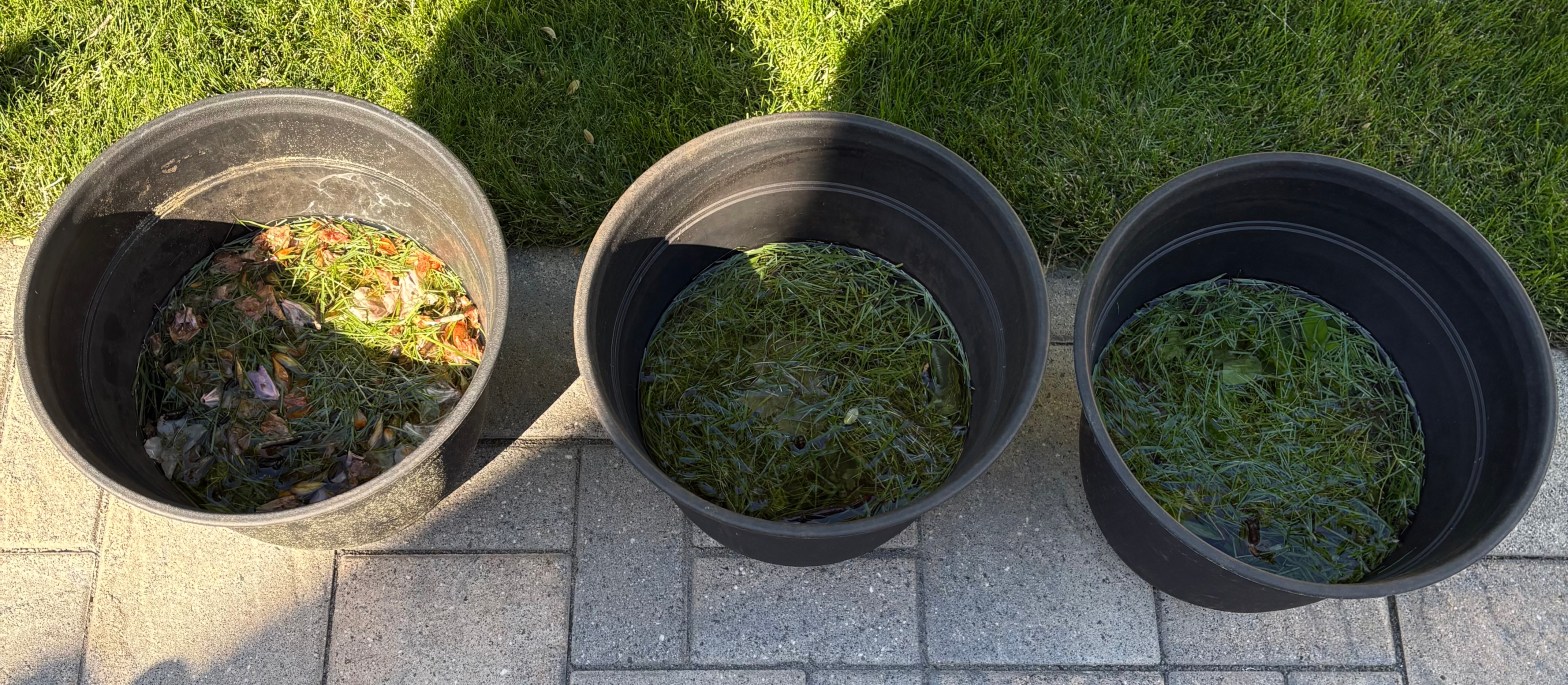
This technique uses a product called Bacillus thuringiensis ssp israelensis or Bti, that is commonly found in a Mosquito Dunk, those little mini-donut things you see in the hardware store. Read the mosquito challenge for details, but, essentially, you fill a 5 gallon buck halfway with water. Put in some grass clipping, leaves or other organic material and let it sit in the sun for a few days to funkify. That’s my word, and the image above is my buckets getting funky. Then you add 1/4 of a Mosquito Dunk and hide the bucket under shrub or tree in a moist, shady area. Put some chicken wire over the top that is small enough that birds, chippies, and the like can’t get in, and put a rock on top. I have a relatively small yard and put three out and had very little mosquito activity after a month. Put a reminder in your phone calendar to add 1/4 a Mosquito Dunk every month. It only takes a few days for larvae to hatch, so don’t forget because without the Bti, you have created a wonderful habitat for Mosquitos to thrive. You don’t want to over fill the container either because rain and irrigation will add to it and remove the Bti if it overflows.
What this bucket does is provide a breeding ground for female mosquitos to lay their eggs, and the Bti kills the larvae. This does not kill adults, so it isn’t immediate, but it collapses the population by stopping new mosquitos. The beauty of this is that it has no impact on any other insect or animal in your garden. OK, the bats may be a little disappointed, but they can go elsewhere.
The last part of this has to do with your garden and its surrounding habitat. For mosquitos, the most important thing is to remove all standing water for egg-laying. A saucer under a plant that always has water, any plastic that holds small amounts of water, a wheelbarrow behind the garage, and anything else.
For ticks, there are a number of less invasive actions. First, consider using Tick Tubes. Ticks don’t move much on their own, but they do hitch a ride on deer, mice and other vermin. Ticks tubes contain a nesting material that vermin like, and it is laced with Permethrin that kills ticks on mice while they are nesting. It works so well because new ticks that keep coming into the nest will come in contact and die. Follow the directions closely for safety and efficacy.
If you are neighboring on woodlands or areas where you know ticks are moving with their animal vectors, you can manage the transition from the woodland to your garden by doing some cleaning of excessive leaf litter, branches, grass and such to minimize nesting and their ability to transition off of the deer and mice. Using Pyrethroids in the soil can provide a strong barrier and won’t have the same insect impact as broad spraying.
Finally, if you have tick issues but need to be in your garden or want to walk freely in the woods, you can effectively spray boots and garments to deter them. the CDC has a great fact sheet, and it links to a Connecticut Handbook on tick management. UMass also has a good fact sheet with great links for more info.
This was a lot, but I ask that you spend a little time to utilize effective and safe applications that don’t collapse the whole ecosystem by indiscriminately killing everything — please. Good information can help you keep free of the challenges of these nasty little pests.
If you want to subscribe for free to my more detailed newsletter, please go to the following link: The Barker, a newsletter for gardeners in New England.
 Barking Dog Gardens - Gardening in New England