Trees! Trees! Trees!
We are going to talk about trees, and hopefully, with the input from a few passionate experts, I can help you to better appreciate and fall in love with the myriad of amazing attributes that they possess.
I am not going to force ideas down your throat, or shame you into ‘taking my side’, but I will share thoughts and information to provide a deeper understanding of these wonderful living entities that we often take for granted and ignore. After reading this, and maybe one of the listed books, you will be able to look at trees with a greater appreciation for their grace, attributes, and importance.
I spoke with three people who have spent their lives growing, planting, pruning, diagnosing, treating, and loving trees:
- Peter Wild – Retired Founder and Owner of Boston Tree Preservation among many other related entities over the years – As an arborist, Peter’s knowledge and experience caring for trees over decades in the Greater Boston area (and world) is unparalleled, and he was an early developer of organic products used in tree care. Before he retired, arguably there was no better tree care company around.
- Alden Johnson – CEO of Barrett Tree Service – While no longer actively climbing trees, Alden now runs one of the top arbor care companies in New England. The passion for trees runs through every employee at this company and it shows in the manner in which they work and care for client’s properties.
- Dan Gregg – Founder/Owner of Grelen Nursery – For over 30 years Dan has overseen the growth of this tree nursery to over 600 acres in the shadow of the Blue Ridge mountains of Virginia. He grows an incredible assortment of trees, often to significant sizes, that are available to the trade and retail clients along the east coast.
When we look at trees that are so big that we can’t wrap our arms around them, but need a family of four or five to get around, we often don’t realize that these trees started growing before electricity, before the Civil War, or maybe even before we were an independent country. While that may seem like a rather exaggerated statement to start, it is true that trees are multigenerational and often take decades to grow before they start to achieve any natural form or grace. Yet we often see trees that have been around for 50 or 100 years removed without a thought.
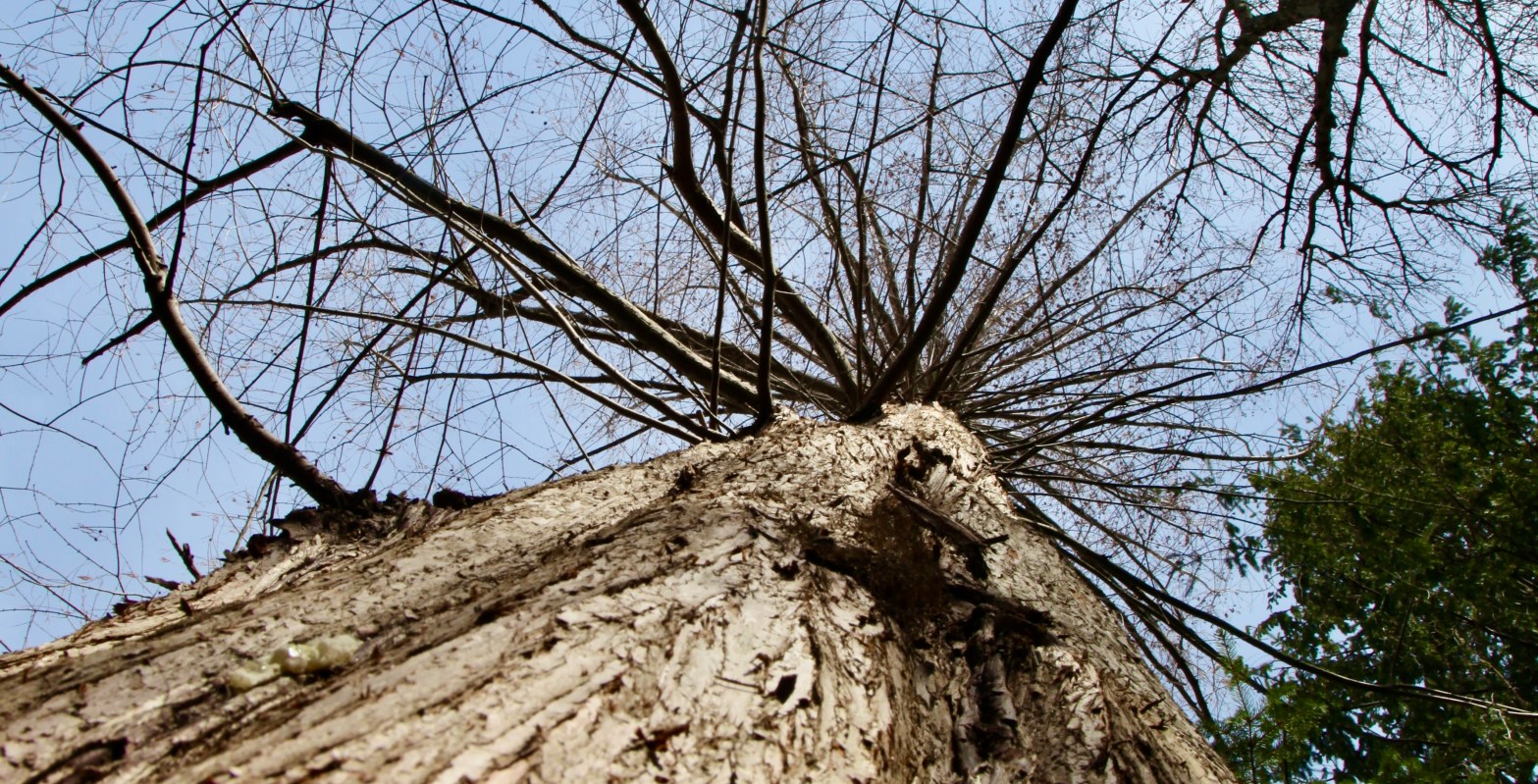
Appreciating their age is one way to take pause and pay attention, by looking up and realizing their height, structure, and inhabitants. At a previous house at which I lived, we had a Sugar Maple that had been planted when the house was built in 1927. It was placed on the western side to protect the house from wind and hot Summer sun. 80 years later, my son and I would toss and kick balls under its expansive shade in the hot Summer. It had probably been struck by lightening 30 or 40 years earlier and lost its central leader, and it had established several leaders that stretched up and out creating a tree wider than it was tall. It was always 5 to 10º cooler underneath in the Summer. I loved looking up into the canopy to see the complex, spreading branches that had been properly pruned by an excellent arborist. My son and friends loved climbing it and sitting on one of the horizontal branches, and throughout the year it was inhabited by all sorts or animals, insects, and birds that were part of the integrated ecosystem. With a minimum or arborist care, pruning, insect outbreak management, it was a stunning, safe specimen that turned a stunning orange/yellow every Fall. A couple of years ago, my neighbor called to say that it had been cut down. When I came to look, there wasn’t one bit of internal decay or rot. After nearly 100 years, it was gone for no legitimate reason.
Dan Gregg of Grelen Nursery, one of my oldest friends, grew up walking his grandfather’s old property in Ohio. Looking up in the canopy of the woods gave him an appreciation for this living environment, and with his grandfather, enjoyed a lean-to they built in the woods. He was also fortunate to have a family farm in Virginia that had a wide selection of mature native and non-native trees. I remember visiting this amazing property and seeing some huge, mature Weeping Japanese Maples on this property filled with mature trees and plants. Japanese Maples were his inspiration and among the first he planted over 30 years ago as he started his nursery. This connection to trees and nature dragged him out of a short, post-school, banking career.
Alden Johnson also grew up in the woods climbing trees. He often spent time in the trees of his father’s orchard or Maple sugaring with his grandfather. This love of nature, and specifically trees has led to a life of professionally climbing and caring for trees. Alden also believes that most of us, if we think back, probably have a connection to a tree or wooded area in which we used to play, and he encourages us to remember how important it was to our youth.
I think if we can recall our youth, maybe we can remember how important trees and woods were to us. I remember a tall tree in a neighbor’s yard with a platform we had built quite high off the ground. I remember a specific day when I was trying to climb to safety on the platform when I was shot in the leg by a BB gun, as we were in the middle of a game of army. As an aside, this family also had lawn darts, and was THE fun place to play. To get to their house in the Winter I could ride my sled down my back yard, into the woods, and through to reach the tree and their yard without stopping…unless a tree got in the way!
Peter Wild, who has forgotten more about trees than I will ever know, talked about trees being very much like people. When trees are well-cared for and in a good environment, they will thrive. However, if they are stressed or don’t have access to proper nutrients, they can suffer from disease and then insect infestations. When trees are in forests, with their leaf litter and rich and undisturbed soils, they will thrive and live longer lives. Unfortunately, trees that exist in lawns and gardens, where they are often deprived of the natural, organic amenities they need to thrive, need additional attention to manage nutrients and disease.
Taking this anthropomorphism a little further, many cultures actually believe that trees have a consciousness. Alden recently told me about a podcast called: This Old Tree. I am hooked on these stories of old trees around the world and their connection to culture and history. When listening to the story of the General Sherman Redwood in the Sierra Nevada range of California, the Native Americans in the mountains believed the Redwoods were sacred living beings and powerful spirits.
Peter also reminded me of several books if you want to dive deeper over these cold, Winter months:
- Secret Life of Plants (1973)
- Hidden Life of Trees: What the feel, how they communicate – Discoveries from a secret world (2016)
- The Overstory (2018)
I was recently gifted a wonderful book that discusses Fungi and how it connects our natural world, especially communities of trees:
In your town there may be a tree or forested area that is of great importance to its residents, and may be a symbol or gathering space. In Winchester, we have a 120+ year old Red Oak that sits on our Town Common. Peter, while going through archived photos helped to age the tree, and given its immense size and volume, we were surprised at its youth. It stands at 100′ with at least that much breadth. Movies, concerts, a farmer’s market, lunches, impromptu gatherings occur under this tree all year long. The common and the tree are an emotional center for the town. Unfortunately, in its urban environment, and with all the activity underneath, it is suffering from some significant challenges.
As Peter was describing earlier, like humans, the tree is under stress, which makes it more susceptible to disease. Alden and a crew from Barrett Tree volunteered their time on Arbor Day in 2023 to prune the tree and remove much of its deadwood. From this event, several modest recommendations were made: Create a ring around the base to minimize foot traffic that was damaging the bark on the root flare, and to start a semi-annual Bio-Stimulant program (feeding) to help it fight its disease. As I understand from Peter, the town started Biostimulant this Fall. From the drought this year, it continues to create more deadwood, and the hope is that this may start to energize the tree to fight the disease.
When I visit Dan, at his nursery in Virginia, he takes great pride in the range of trees he grows. He loves it during Fall and Winter when he can quiz me on the trees when they don’t have any leaves. I fail miserably to identify, but in this setting, it is easy to see the variety of forms, bark, textures, and colors. I consider myself lucky to have experts like these mentioned so that I don’t have to remember every detail of the hundreds of trees we can grow in New England.
Just like in our own landscape, for a modest cost, we can keep our landscape trees healthy, safe, and beautiful. This involves providing what they need that the specific environment does not. Often times decades of care will cost much less than removal and replacement. In talking with Alden, we couldn’t even estimate the cost of removing the Red Oak on the Town Common, given it shear size and the weight in the 40+’, 8′ diameter trunk, but it is far more than it would cost to treat the tree for a decade or more… let alone the loss of such an important symbol of our town that would not be easily replaced for several generations.
Alden shared some of the disease challenges his company is seeing on client properties. There are many forms of rust and fungus that they are dealing with, and recent seasons with wet Springs and dry, hot Summers have made them worse. A number of recent droughts are putting added stress on trees bringing on many more specific diseases. With disease and stress come insects that cause damage, as well as recent foreign introductions that are wrecking havoc regardless of conditions.
With these challenges, it is important that you have a quality, certified arborist take a look at your trees every couple of years. Just like going the the doctor for an annual check-up, it is an opportunity to find issues before they become entrenched and possibly existential. If you have gotten to this far, then hopefully I have helped you to fondly remember a tree in your past, and maybe you are going to look at your own trees a little differently. Yes, proper tree care does cost a little money but no where near the cost of removing and replacing… and remember, trees take decades and more to achieve the grace and aesthetics of your existing, aged specimens.
As promised, I had no agenda but to help reconnect you to trees and appreciate their beauty and importance. I encourage you to find one of the mentioned books or listen to the podcast. Also, consider giving your trees the attention, love, and respect that they deserve.
If you want to subscribe for free to my more detailed newsletter, please go to the following link: The Barker, a newsletter for gardeners in New England.
 Barking Dog Gardens - Gardening in New England
My favorite subject.
LikeLike