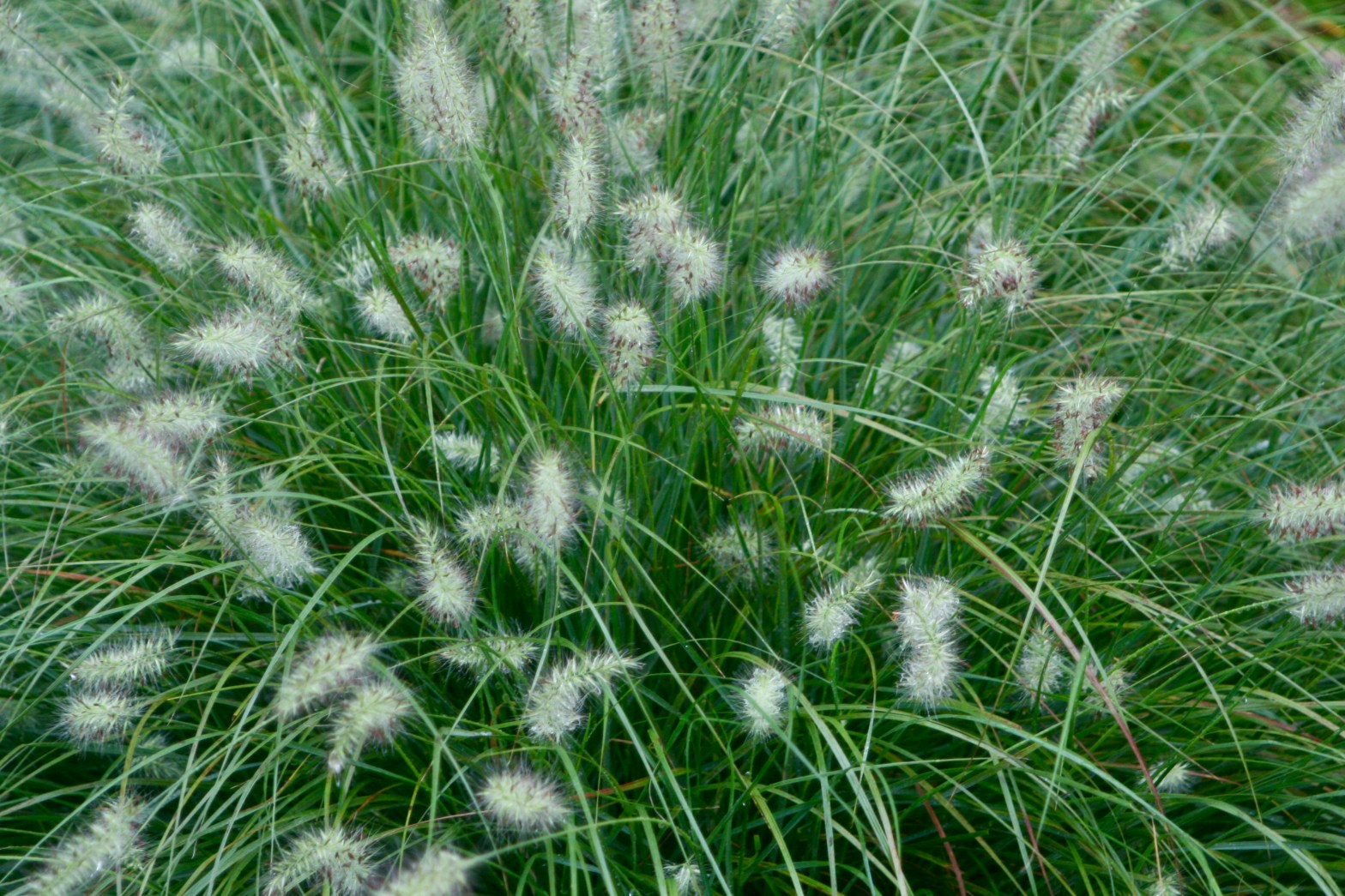
Ornamental grasses are some of the most versatile and beautiful plants you can add to your garden. Many provide interest and coverage through the Winter and their seedheads can be a spectacular addition of interest and movement to the garden in Summer, Fall and Winter. Some of the larger grasses provide an anchoring element, while some modestly sized grasses provide a dynamic and softening element to the garden.
While they have been adopted more in recent decades, I still think it is a missed opportunity for many gardeners. Also, general nurseries and garden centers tend to carry limited varieties, and often they are not placed properly in gardens. One of the most common grasses we see in gardens are the family of Miscanthus or Japanese Maiden Grass. Most, not all, of the grasses in this family are large, some up to 6-8′, and they aren’t appropriate for smaller gardens. They require 6-8 hours of sun, and can be floppy and disappointing if these conditions aren’t met.
On the positive side, there is a grass for almost every situation. Now, when I say grass, I am also including other similar looking plants like sedges and rushes, that are completely different plants but share a similar form and look. Most prefer full sun, a minimum of water, average soil, and require little maintenance other than a cut back in the late Winter. However, there are plenty of grasses for moist soil in part shade and even shade. If your garden has the space, using multiple grasses in waves provides an informal, dynamic and natural aesthetic. For many people, just adding grass to their garden is a step, but for others the goal is to create a more naturalistic and sustainable garden.
For inspiration, you can look to the work of Oehme, van Sweden, a landscape architecture firm that supports the New American Garden concept, and the firm of Piet Oudolf, who in a similar fashion uses plants in natural designs using large drifts of plants with lots of grasses. For those who are looking to create more sustainable and native gardens, grasses need to be a key component of these designs as they provide interest when most other plants are dormant.
If you really want to learn more, The Encyclopedia of Ornamental Grasses by Jonathan Greenlee is a comprehensive resource. It was relatively new when I was in school nearly 30 years ago, but it holds up well as a resource and is available for a few dollars. It doesn’t include the latest cultivars, but provides great detail on the important genus.
Of course, I have a few favorites that work well in smaller gardens and are stunning in larger groups and waves:
- Calamagrostis acutiflora ‘Karl Foerster’ (Feather Reed Grass) – Wonderful, medium-sized, upright grass for sun with very long season for seed heads.
- Carex pennsyvanica (Pennsylvania Sedge) – No maintenance to 12″ that falls in waves when grouped to look like a flowing stream. Great native lawn substitute in sun to shade.
- Schizachyrium scoparium (Little Bluestem) – Beautifully colored native grass with blueish shade and red blushes. Medium sized with great ecosystem value in sun.
- Chasmanthium latifolium (Northern Sea Oats) – Beautiful, drooping, medium-sized grass for part-shade to shade with very cool flat oat shaped seedheads.
- Sporobolus heterolepis (Northern Dropseed) – Lovely, soft clumps of arching, native grass with great fall color in sun/part shade in dry soil. 2′
Following is a selection of both native and non-native grasses that are wonderful in the garden and generally available. There are often several different cultivars of the following Genus.
Tall Grasses (Over 4′)
- Sorghastrum nutans (Yellow Prairie Grass) – Tall, upright, native grass with feathery seeds in late summer and yellow fall color. 5+’ in drier soil.
- Andropogon gerardii (Big Bluestem) – A native, monster with blueish stems and relatively early seedheads in full sun and average moisture. 5+’
- Miscanthus ‘Pupurescens’ (Purpurescens Maiden Grass) – Beautiful upright grass with fluffy seedheads in full sun and average soil. Turns stunning, reddish color in Fall. 4+’
- Panicum ‘Heavy Metal’ (Heavy Metal Switch Grass) – Very upright grass with blueish stems and yellow fall color in full sun and average soil. 4+’
- Molinia ‘Skyracer’ (Purple Moor Grass) – Great arching grass to 3′ with summer, purple seedheads that grow to 6′. Very dramatic. Grow in sun to part shade in dry to moist soil.
Small/Medium Grasses (Under 4′)
- Deschampsia flexuosa (Wavy Hair Grass) – Native sun to shade in drier soils with late summer seedheads. 2′
- Juncus effusus (Soft Rush) – Stiff, hollow stems form a spiky looking, native plant for full sun and moist soil. 3′
- Pennisetum orientale ‘Karley Rose’ (Oriental Fountain Grass) – clumps of gray/green grass on this fountain grass, with beautiful pink seeheads in late summer in sun and average soil. 2.5′
- Eragrostis spectabalis (Purple Lovegrass) – Native for that tough, dry, sunny spot, this low gray/green grass with purple seedheads. 2′
- Carex stricta (Tussock Sedge) – A classic sedge for wet soil and rain gardens in sun/part shade. Forms tussocks when grouped. 3′
- Miscanthus ‘Adagio’ (Adagio Maiden Grass) – More compact form of the big Maiden grasses with a vase-like shape and late-season fluffy seedheads that hold well in winter. 3′
 Barking Dog Gardens - Gardening in New England