OK, here we go. Two soapboxes stacked, megaphone fully charged, attitude on, and hyperbole activated!
Mulch can be the greatest input for your garden and plants or it can create a desolate wasteland. How’s that for hyperbole?
I know that readers of this newsletter span a great range of gardens from small fractions of an acre to dozens of acres. When I talk about mulching, I am mostly focused on the ornamental parts of your garden, those that you care for and work with flowering shrubs, ornamental trees and perennial and annual gardens. It also includes vegetable gardens.
During the course of a season, we often remove a lot of organic material from our gardens: Fruit, leaves, flowers, pruned branches, dead annuals, cut down dormant perennials, etc. All of this organic material has to come from the soil. So whether you are mulching with compost, leaf mold, wood mulch or fallen leaves, the idea is that you are returning the organic material to the soil to be used in the future. Think about the self-sustaining forest where you go hiking where it is all contained and fallen leaves create their own mulch.
So what does mulch do:
- Adds organic matter to the soil
- Supresses weed growth and germination
- Moderates soil temperature swings
- Minimizes moisture evaporation from soil
Types of Mulch
Bark and Wood mulches are the most commonly used. Unfortunately during the last decade or so we have seen a huge increase in dyed wood mulch that does not have the benefits. Pine/Spruce, Hemlock and Aged Dark mulch are the most common natural mulches, and you sometimes have to search for quality ones. Be wary of a supplier or contractor selling your ‘red’ or ‘black’ mulch. Fresh wood chips are also good for your larger plants material as they tend to be bigger chunks, and contain wood, bark, twigs, and leaves. If you have the space have your arborist leave your chipped material or buy a chipper and chip your own matter.
My favorite mulch product is a leaf mulch called MadMics. It is a combination of leaves and horse bedding (hay, wood shavings with some urine and manure). It is ground three times and composted to eliminate seeds and any pathogens. I have found through soil testing that after several years this mulch adds nutrients to the soil and limits the amount of fertilization required.
This is best used around perennial/annual beds and other ornamental plants. No need to waste it under a grove of pine trees, where wood chips might be best used.
Recently, a lot of suppliers have been providing their own leaf mold, which is ground leaves that have been composted (sometimes). These products are lighter than MadMics as it doesn’t have some of the added elements, and breaks down before the end of the season. Ask the supplier if it has been composted or it may be bringing in some weed seeds.
Sweet Peet is another good product which is loaded with good things and excellent for veggie and ornamental gardens. You can also find it bagged in some nurseries, and it tends to be a little heavier than MadMics.
Application
Generally around trees and shrubs you can apply 2-3″, while only using 1-2″ around perennials. Heavier wood mulches require less as they are denser and break down more slowly, while the leaf molds are lighter, will settle, and break down more quickly, so a little more can be used.
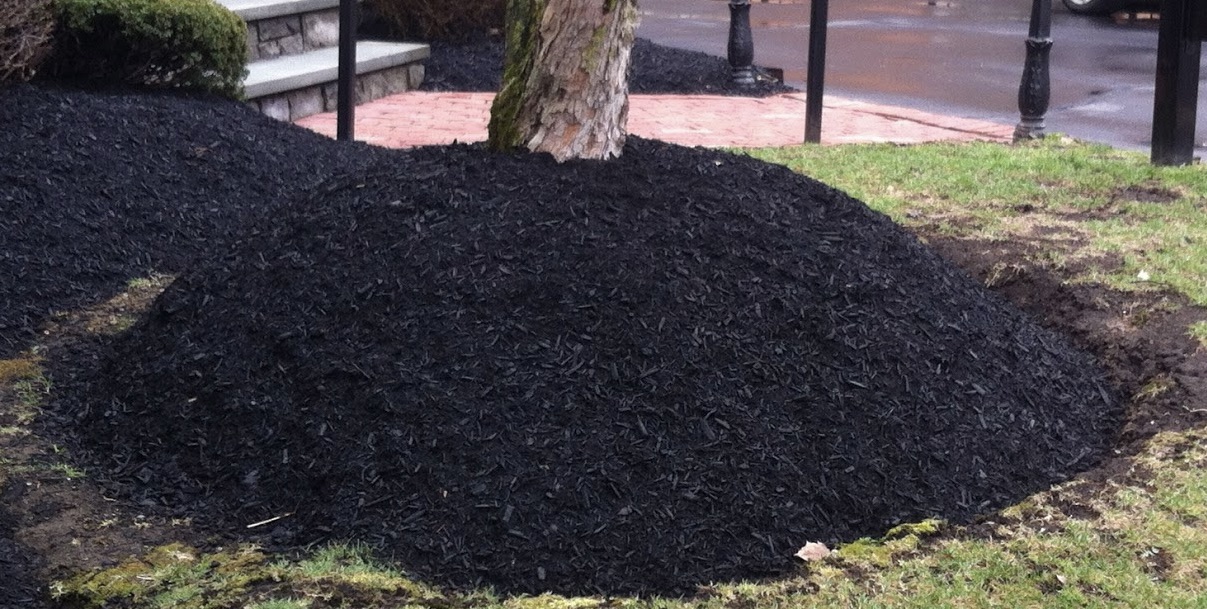
The most important principle is that mulch should never be used to raise the grade around plants. Burying plant root crowns and flares under layers of mulch will suffocate and kill them. With larger plants and trees we want to avoid the ‘Mulch Volcano’, where giant mounds are built up around the base over years. It won’t kill them immediately, but it will as they are suffocated and girdling roots form to strangle the trees.
Instead, mulch Donuts not Volcanos. Keep the mulch from building up on the base of plants and trees. You can leave a hole in the center. Notice in the left image the trunk is straight as it goes into the mulch. The flare, where these trees spread out is covered and is very problematic. The image on the right shows how the flare should be exposed. This needs to be the case with shrubs, too, just on a smaller scale. Do not build up the soil level around plants with mulch, as you will ultimately pay for it.


It’s worth it!
I hear it all the time: It’s expensive and a lot of work. Yes it is and it is worth the expense and effort. For the benefits listed above, it can minimize a lot of other work during the season. For your ornamental gardens, healthier plants and better soil make all the difference.
 Barking Dog Gardens - Gardening in New England