I know everyone who reads this isn’t a horticultural geek or numbers nerd like me, but take a few minutes and learn about this incredible resource we have in the Boston area called the Blue Hill Observatory. When I talk about weather, in my in-season newsletters, I am often linking to and using data from Blue Hill.
Following is their mission, and they have been doing it since 1885:
Our mission is to foster public understanding of Earth’s weather, climate and environmental systems and to continue to produce, maintain, and analyze a meticulous, consistent record of weather and climate observations.
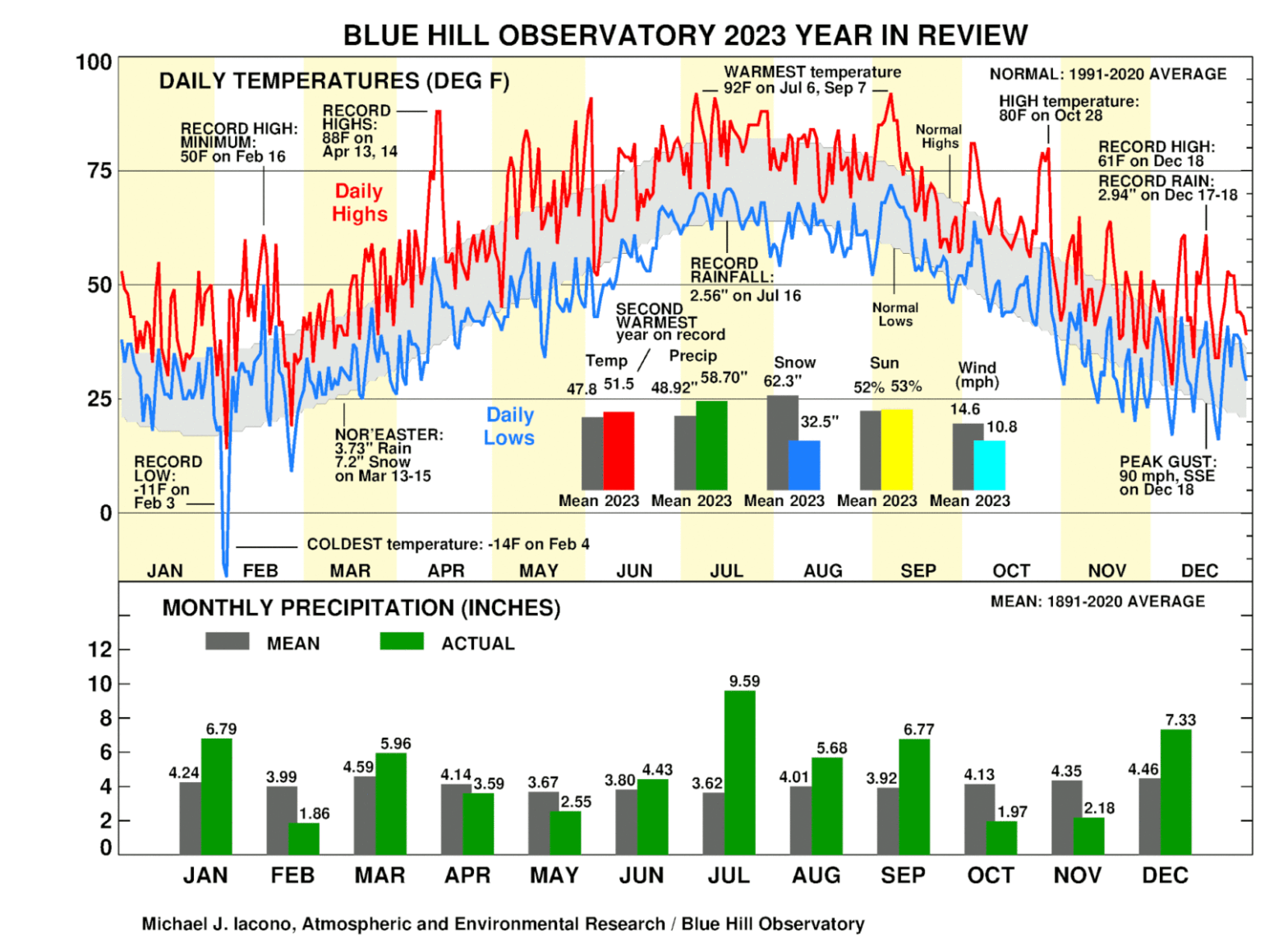
Most importantly, they collect data and have been doing it every day for nearly 150 years, and are an important part of a global network of weather observatories. Following is the Blue Hill 2023 Summary, with a fantastic image that shows all the data and highlights on one image, seen below.
The highlights of the weather summary by Chief Scientist, Mike Iacono, are as follows.
- 2023 was the second warmest on record since 1885. With 24 hour mean temperature of 51.5ºf it was 3.7ºf above the 130 year mean average.
- Each of the last four years is among the 8 warmest since 1885, and the 10 warmest have all occurred since 1998.
- June and August were cooler than average, and December was the second warmest on record.
- 2022/23 Winter was the fourth warmest on record.
- 58.7″ of rain was nearly 10″ more than the 130 year average. See rainfall graph below.
- July was the wettest month with 9.59″ of rain being the sixth wettest July on record.
If you spend a little time on their site, you can explore all the data they have in graphs. Under category, I love looking at the Long-Term Climate Graphs and the Annual Summary Graphs.
The best explanation for understanding the difference between weather and climate is that weather is what we experience in the moment and climate is the aggregation of weather over time. Without getting into the ‘Why’, all you have to do is look at the temperature graph over the history of Blue Hill to see that we are clearly going through a change in climate, like the earth has throughout its existence. I am not going to try to explain why, but simply share the data.
And with the 2023 summary showing that the 10 warmest years in recorded history have happened in the last 25 years, it is clear that it is accelerating in recent times.
That is all the data reveals. Though I did ask Mike Iacono if he could offer some explanation for the inconsistent weather and temperatures we seem to be having in recent Winters, that is causing real challenges in our gardens. Following is his response:
As to your question, science is still working to understand all of the implications of our changing climate. The variability of winter weather largely comes down to how the many factors that can influence winter weather interact with each other. These factors include 1) changes in equatorial Pacific Ocean temperature (“El Nino”), which varies on multi-year cycles; 2) variations in surface pressure patterns at high and middle latitudes (“Arctic Oscillation”), which can either hold cold air over polar areas or allow it to move southward depending on its state; 3) the extent of snow cover over the land areas (and ice cover over the Arctic Ocean), which can help cold air masses to build during winter and to move farther when snow cover is extensive; 4) the position of the storm track, which can weaken or strengthen storms depending on its orientation; and many, many other factors. During some winters only one of these factors will dominate for many weeks, such as the period of severe winter we had in January-February 2015, and hold one weather pattern in place, while in other winters multiple factors will compete and cause more frequent swings. In addition, as the climate warms we expect more extremes to occur on regional scales, though the reasons for this are still being investigated.
They also are conducting research with other scientists around the world on the data that they track. Wind Speed has been dropping significantly for over 40 years, and they are working to try and determine the cause as it is not unique to the US or New England. Sunlight brightness trends have shifted over recent decades with the introduction and banning of aerosols. They have all the data from daily measurements that help in this research. I can’t wait to find out what they learn.

 Barking Dog Gardens - Gardening in New England