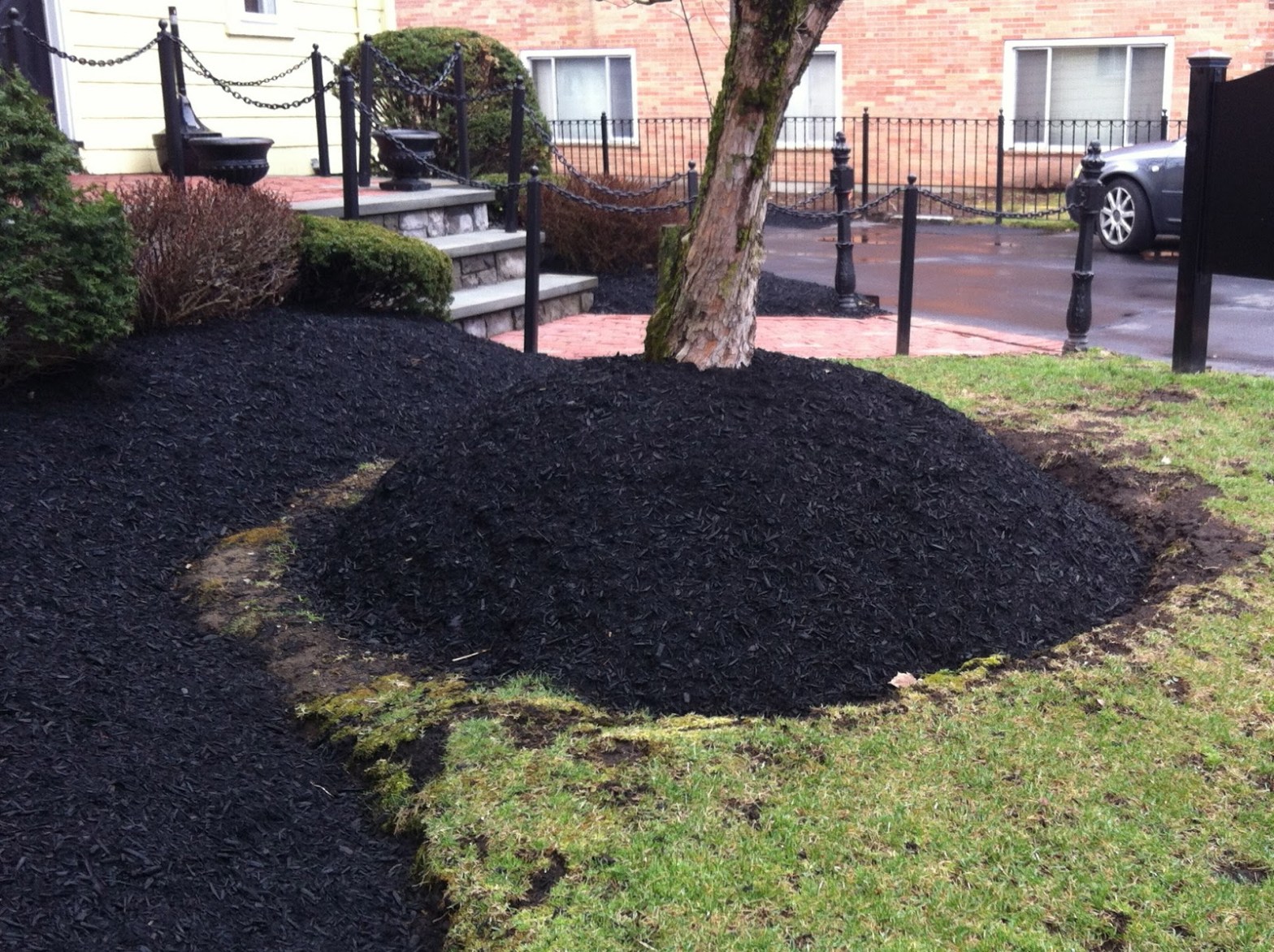
Welcome to the annual process of building up soil levels around the base of plants with excessive amounts of mulch. The result of this reckless heaving of mulch around trees is the ubiquitous “Tree Volcano”. All of these images are from local sites showing egregious use of mulch, and some bad quality mulch too.

For those of us who live in suburbia, the annual rite of spring is the arrival of numerous ‘mow and blow’ contractors who come to clean up the gardens and lawns and get them ready for the coming season. For many it means multiple gas blowers, both backpack and ground, de-thatchers, mowers and a small army of workers edging, pruning, raking and the grand finale of laying mulch.
As someone who spends time trying to educate clients about their gardens and proper maintenance practices, it is infuriating to see so-called professionals killing their client’s gardens. That said, there are plenty of reputable contractors who perform excellent work, but often in search of saving a few dollars, people go with contractors who promise the same work for less. Over time, it costs so much more.
I want to focus on three important aspects of putting mulch down in your garden: Preparation, Material, and Quantity.

Preparation
The worst practice is to pile new mulch on top of old mulch. When prepping beds, often you will find that raking out the existing mulch may provide partial or even substantial coverage for the coming season, and it is important to rake out the mulch, turn it over and let air in to help in the decomposition process. If you want to add a thin layer of new mulch on top of the old mulch, that is great, provided you are not building up the level around your plants. Adding mulch or soil around the base of plants will contribute to their demise by burying the root crown and keeping air out of the root zone which is critical along with water and nutrients. Demise and death come slowly.
The soil level around plants should remain the same year after year. A contractor I spoke with said that clients like the mounding in beds and he uses mulch to raise the profile of the bed. If you want to raise a bed then you need to remove the plants and add back after the grade has been adjusted with soil, but you have to be careful changing grade around large established trees. Away from the trunk, some trees are OK with grade adjustments, while others can be very sensitive to having their surface roots buried.
Many contractors will remove old mulch and add a whole new layer of new mulch because they want the fresh look of new mulch. Unfortunately, by doing this they are removing a layer of mulch that has been decomposing for a year and is that much closer to providing available nutrients and organic matter for the soil.
In fact the whole process of removing material from beds is part of the problem. Gardens need every bit of organic material to help them regenerate each spring. Like everyone else I can appreciate a neat and clean garden bed, and in the fall I remove leaves only to return them in the fall as shredded mulch or in the spring as leaf mold.
As a final word on preparation, make sure you are providing the best opportunity for your garden to receive good organic material to improve the soil quality and help supply nutrients for your growing plants. While mulching can be seen as a decorative element, it should primarily be seen as an opportunity to improve the quality of your soil, keep in moisture, and provide protection from weeds and heat during the season.

Material
Many people love the look when their gardens are clean and have been mulched with red, brown or black mulch. The purpose of using a natural mulch is to decrease weeds and weed germination, keep soil moist and at constant temperature and most importantly to add organic material to beds that are asked to produce flowers, shrubs and trees year after year. Organic material that is utilized by plants, needs to be replaced and mulch and compost are critical elements in this cycle.
In recent years, the demand for mulch has outgrown the supply of quality mulch and suppliers have created mulch that is made from recycled wood products that need to be dyed, badly I might add, to replicate the natural color of brown Pine and Spruce bark mulch, reddish brown Hemlock mulch or the aged and composted black mulch. These ‘created’ mulches have no value to existing soils and often steal nitrogen from the soil so that they can decompose and they do so at a very slow rate. The really bad mulches bleach out during the summer as their dye wears off to reveal chunks of recycled wood. These mulches take years to break down and can cause more harm than good by removing nutrients from the soil that your plants need.
The best products to use as mulch for flower and shrub beds are composted or aged mulches, compost or my favorite product, Mad Mics Mulch. If you want to save a lot of money in mulch, you can recycle your leaves in a very simple process. In the fall when the leaves are dry, I spread out a days worth of raking on my driveway and go over it several times with my lawnmower. This helps to break up the leaves into smaller pieces and helps in the decomposition process. If you want, you can buy a small garden shredder/chipper and run them through to get a more even consistency. When I used to have space, I put the leaves in a corner behind my house and added a few pounds of Dried Blood, an organic amendment available at most any garden center. Dried Blood is pure nitrogen that will help the leaves to compost until spring. Come spring when my beds are prepped and it has started to warm, I liberally add the leaves back to my garden beds.
If you don’t want to go through this process, find a local supplier of Leaf Mold or Mad Mics Mulch. It is one of the best amendments for perennial gardens. As for woody mulch, talk to your supplier or landscaper and make sure that you understand the type of mulch that you are purchasing.

Quantity
So how much mulch is necessary to suppress weeds but also allow water to penetrate to the plant roots. For most garden beds, 2-3″ is plenty, and around perennials I would suggest slightly less, especially if it is a woody mulch. If you add fertilizer for perennials or other plants during the season, too much mulch will limit the amount of nutrients to actually get to the plants.
With the proper amount of quality mulch, much of it will break down during the course of the season and be available for the soil and plants. Compost and leaf mold will break down completely and work into the soil during the season. On my property and with clients, by the Spring all of the leaf mold and Mad Mics has broken down into the soil.
All of the images in this post were taken within a five minute drive of my house and all were done by professional companies. Our plants are under enough stress from environmental conditions, new disease and insects, and the last thing we need to do is add poor management practices.
I am now stepping off my soap box!
 Barking Dog Gardens - Gardening in New England