First, thanks to many of you who attended to my pruning class online the other day at Tower Hill Botanic Garden. Your comments and thoughts are well appreciated. If you missed it, you can find the video available online for the next two months, including the Q&A at Tower Hill Botanic Garden. For the modest cost, it is packed with some great pruning information.
We can spend so much money in nurseries and garden centers every Spring as gardens come back to life, as there really is nothing more exhilarating than seeing a new season’s worth of plants show up in March and April. I know, I am a bit of a plant geek. Often, we are also buying many of the same annual plants year over year. There is nothing wrong with that at all, and wouldn’t it be nice if we didn’t have to buy those same plants every year. Many of the plants we grow as annuals here in New England are considered perennials elsewhere as they don’t have to endure our weather conditions. Lantana, Coleus, Petunias and most other ‘annuals’ we plant are actually perennials in very specific climate zones. With this knowledge, there is something you can do to save a little money and more importantly, stay close to your plants over the winter.
You can grow new plants from the existing annuals in your containers and gardens, or you can get an early start on the season by growing plants, veggies and herbs from seed.
This blog, I will spend a little time talking about propagation as seeding will come in the early part of next year. Propagation is the process of creating new plants from existing stock. Let’s use coleus as a simple example knowing that this process can be replicated for many other annuals. There are many resources to learn about the specific needs of individual plants, but a surprising number of our annuals can be replicated this way.
With Coleus, and most plants, a stem has various nodes from which buds and leaves emerge. On a coleus the buds, or leaves, emerge in twos opposite each other on the stem, and new leaves emerge every couple of inches going up the stem. If we cut just below one of the points where the leaves emerge and cut off the leaves without cutting into the buds and stem, this will become the base of a new plant. Without getting into technical botanical details, the material in the stems where these buds exist can form into leaves or create roots. If you have ever seen a shrub that has a branch bent over into the soil and it starts to root, this is the same process. With shrub propagation we call this layering by bending branches into the soil to root new plants.
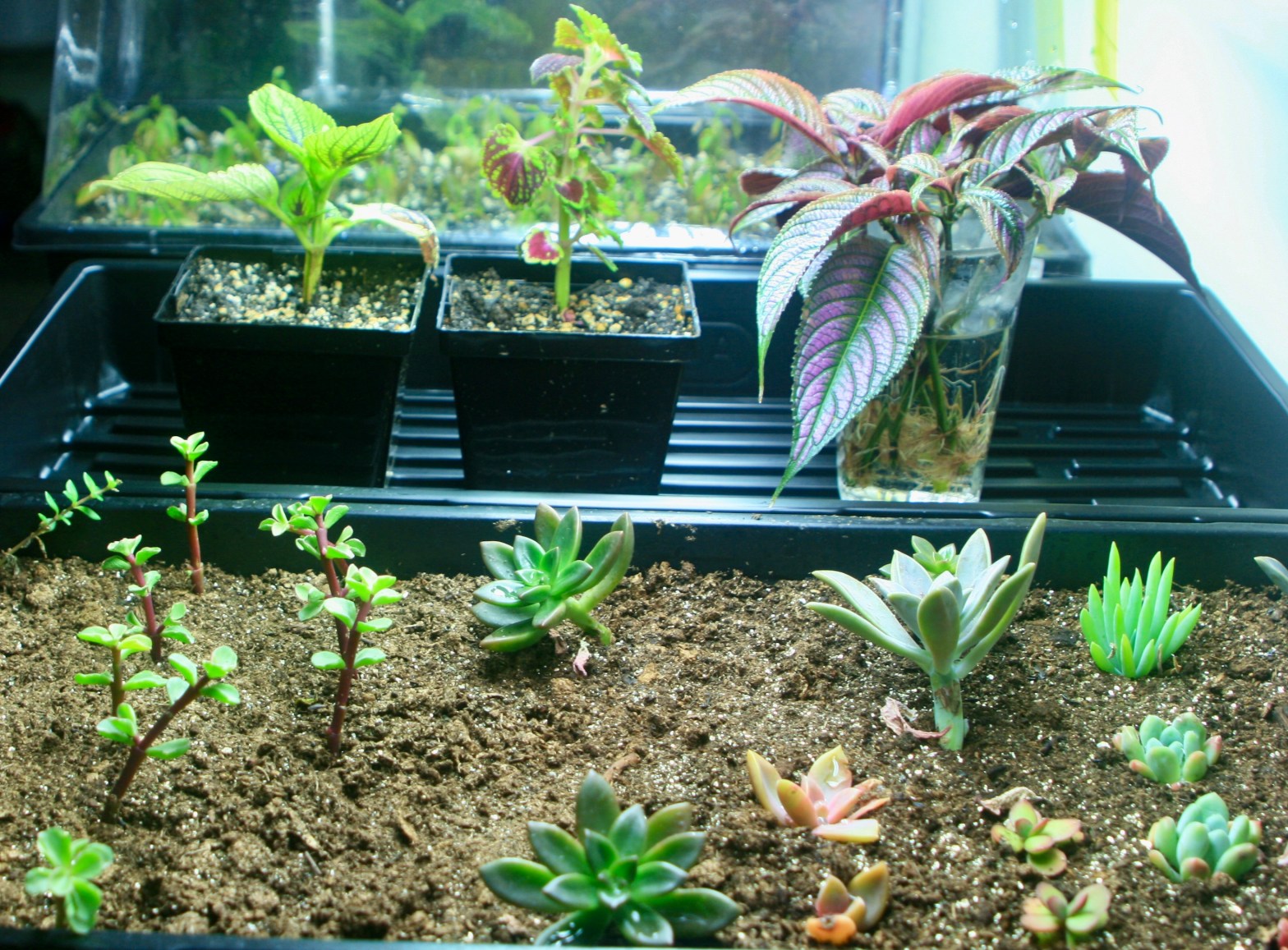
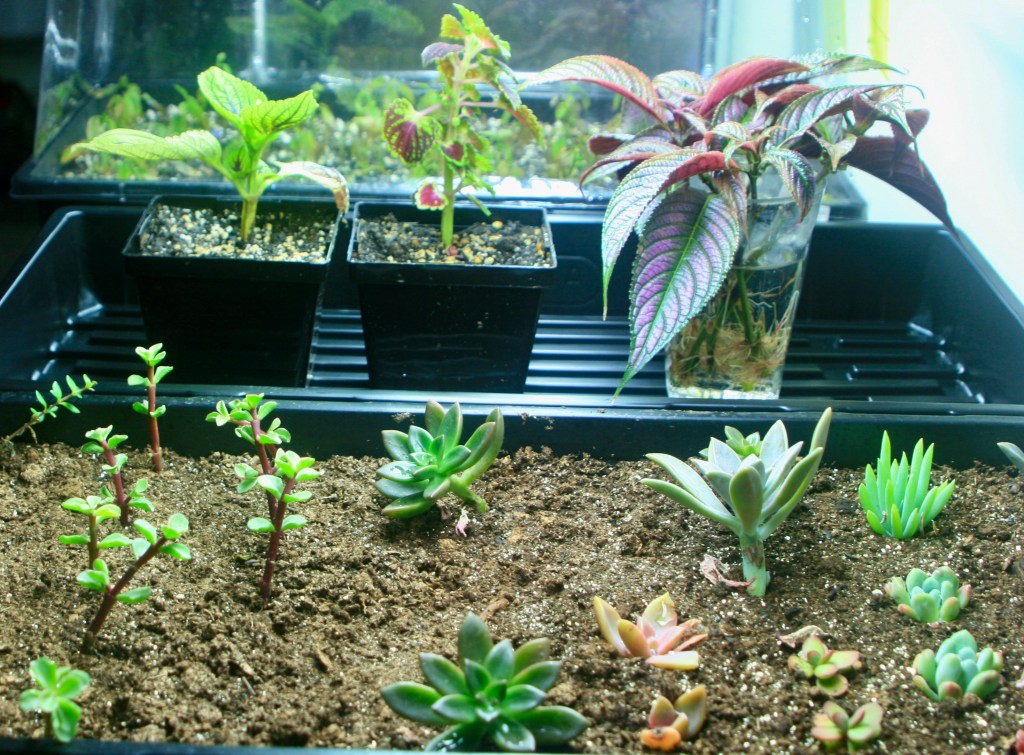
Take a stem on a Coleus and nip off any flowers and look down five or six inches and cut just below a node where the leaves or buds are. Clip off the lower set or two of leaves, leaving at least one set of leaves on top. Do this for several stems or try different plants.
You can now do one of two things. You can put the stems in a glass of water and let them root over a few weeks or you can ‘stick’ the stems right into a light potting mix (Peat Moss, Perlite and Vermiculite mix). The only other supplies you will need is some source for light as a sunny window isn’t really enough for good propagation. For less than $100 you can get a good fluorescent grow light bulb and fixture and some growing pots and trays. By changing the water every few days in the glass you will keep your plants disease free or keeping the soil moist if you ‘stuck’ them. Within a month they should be rooting, and if you have it in a glass, you can put in soil after the roots are at least an inch long. You can tell that your plant is rooting if it is putting on any new growth.
Soon you will have a genetically identical plant to the one you grew last season. You can grow it and plant in the spring, or you can use it as source material to do this process over again in the late Winter to create a bunch of new plants. If you just create 10-15 new plants, you will cover the cost of your investment in growing materials. Without much space and a multi-level shelf you can do far more than that and have plenty of room to grow herbs and annuals from seed in the spring too!
I just wanted to give you a little taste of how easy it is to do your own growing, there are many online and book resources to give you a much deeper understanding.
With everyone being home a little more, I can’t think of anything more rewarding than doing a little indoor plant growing over the winter and we will talk about growing from seed in the Winter. Check out these two resources, The Ken Druse book is beautiful and covers all types of propagation from trees and shrubs to annuals.
 Barking Dog Gardens - Gardening in New England